Three Essential Skills for Better Coaching Conversations
How to help someone live up to more of their potential


Think of a time when you experienced a conversation that left you with a new perspective or perhaps an inquiry or you might have felt that something has shifted in you after that conversation. Maybe it helped you gain a new level of clarity or moved you to take action. That was a coaching conversation.
That’s how I define a coaching conversation. When I think of it, it seems like it covers most conversations especially if you listen, you’re curious and you acknowledge what’s happening to you and to the other person or team.
I think most of us have a coaching conversation on a regular basis but we don’t usually call it a coaching conversation. You don’t need to become a coach to have these kind of conversations. What if you pay close attention to your conversation and notice what’s going on?
Think about a recent conversation, how might you describe it in one or two words? What did you notice? What could have you done differently to make the conversation even better?
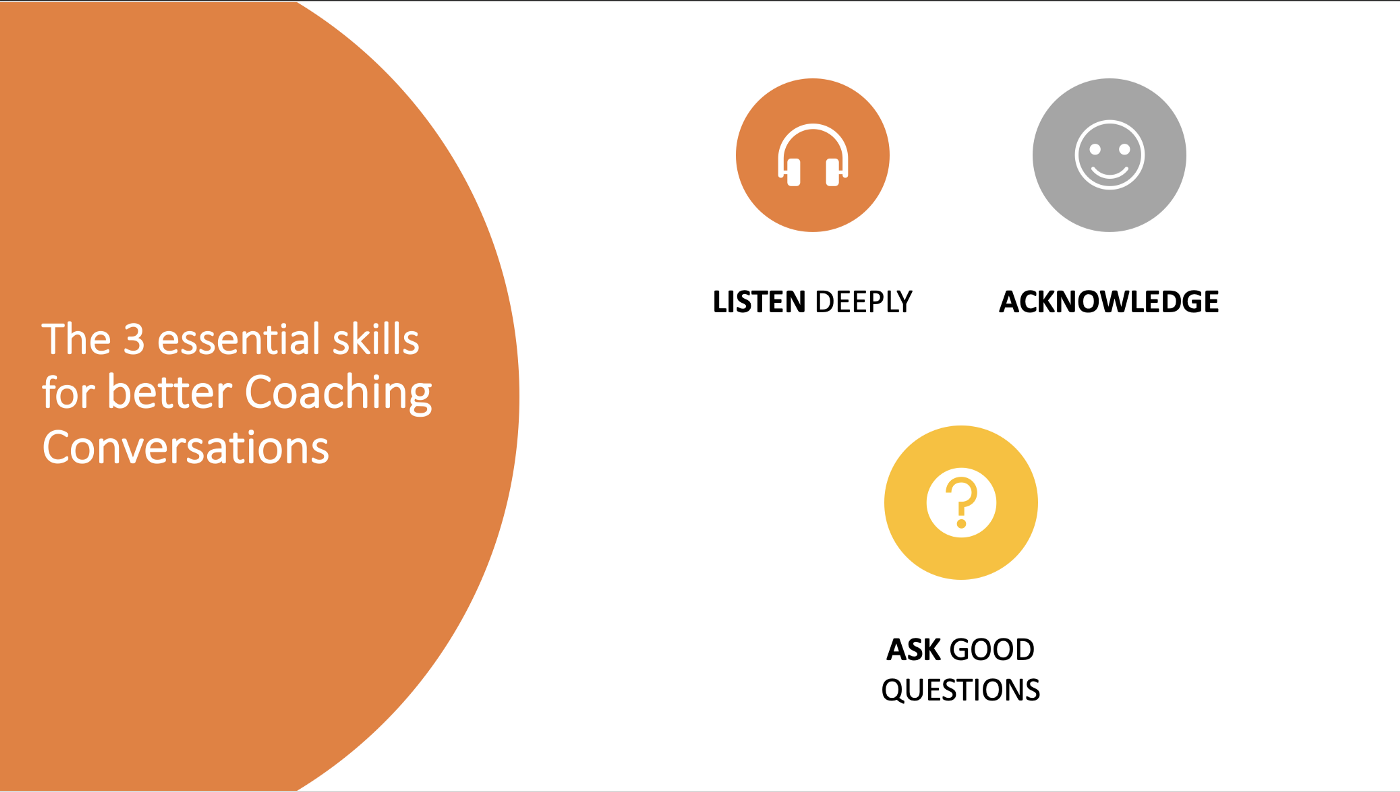
If your conversation didn’t go as you would like it to go, don’t be too hard on yourself. The following are 3 essential skills that could make your next conversation better:
1. Listen deeply
Most people do not listen with the intent to understand; they listen with the intent to reply. — Stephen Covey
Let’s go back to that recent conversation you thought of earlier. Did you feel like you were being listened to? How could you tell?
Most of us could tell whether the person we’re having a conversation with is listening deeply or pretending to listen or listen to reply(also hear) or listen to understand or listen deeply. There are many articles and literature out there about the modalities of listening or the types of listening. We know intuitively when we are listened to even when we are not aware of these modalities.
That being said, I noticed 4 modes of listening that could bring more awareness to how we listen:
Pretending to listen: Usually multitasking as you listen or hear and the multitasking doesn’t necessarily have to be visible. You could be multitasking in your head like thinking about what you are going to have for lunch as you are having a conversation. It’s like switching between different tabs in your browser. :)
Listen to reply (also hear): You are only hearing what’s being said while you think for an answer. You are basically in your head but you hear a word here and there to show you are listening.
Listen to understand: You listen for perspective or a point of view and try to understand what the person is saying and what makes it important to them.
Listen deeply: When you listen deeply, you are not only listening to the words being said but to the tone of voice, the emotion and the facial expressions (if the conversation is on video or in person).
This is a foundational skill and the building block to having a better coaching conversation or just about any conversation for that matter. First step to developing a new skill is awareness so notice your default mode of listening, obstacles that get in the way of listening deeply and what you could do to listen deeply at your next conversation.
2. Acknowledge
Acknowledgment doesn’t usually come naturally to us. I mean, when was the last time you acknowledged yourself? It feels awkward to acknowledge ourselves let alone acknowledging others. If you can’t acknowledge yourself however, it will be much harder to acknowledge others.
Acknowledging what’s happening for the person or team and/or the situation is another essential skill for a better coaching conversation. Feeling heard or deeply listened to is one thing but feeling seen is another. Acknowledgement is feeling seen. Acknowledgement is a gift to the receiver and who doesn’t like receiving gifts.
When we receive an acknowledgment, we feel seen and when we feel seen we expand and something shifts in us. Acknowledgement is a skill and a skill gets better with practice. You can start with something simple like, “This must have been hard for you.” or “I see you are trying hard and it’s not going unnoticed.”
Find something resonant about the other person during your next conversation and acknowledge it or them. Remember, you need to listen deeply to acknowledge the person and/or the situation.
3. Ask Good Questions
To me, good questions are questions that are asked at the right moment. You know a good question when you hear it. It jolts you or has an impact on you. You may have to pause or think in order to answer it. I tell a story about how I started my podcast by asking myself, “So, what’s stopping you?” which was a question a friend asked me when I was trying to start something and kept making up excuses.
Good questions are usually open-ended, they make us pause and think and we don’t usually know the answer (it’s a curious question!). Examples of good questions are:
What makes this important to you?
What are your options?
What’s stopping you?
What have you tried?
What’s next for you?
So, there you have it. The 3 essential skills for better coaching conversations. I hope you try one or all of them at your next conversation and I am confident it will be a better conversation.
I host The Coaching Conversation Podcast and I invite you to give it a listen on soundcloud (also available on Spotify and Apple podcasts) and offer your thoughts and feedback.
Interested in having a coaching conversation to get clarity or take action, you can find a time to connect with me here.
This post was originally published at https://betterhumans.pub/the-3-essential-skills-for-better-coaching-conversations-fc175fba6a3a